It was recently reported that Sallie Mae, the nation's largest student loan company, has already spent $2 million this year lobbying against President Obama's plan to eliminate bank subsidies and replace them with historic investments in direct aid. This plan is reflected in the Student Aid and Fiscal Responsibility Act which passed the House Education and Labor Committee last week. The non-partisan Congressional Budget Office estimates ending the subsidies will save $87 billion in 10 years, much of which will go towards the Pell grant and Perkins loan.
"The banks and lenders who have reaped a windfall from these subsidies have mobilized an army of lobbyists," Obama said in a weekly radio address earlier this year. "I know they're gearing up for a fight as we speak. My message to them is this: So am I."
The President's confidence is encouraging, considering Sallie Mae spent $3.4 million on lobbying last year, including $10 thousand on the "Blue Dog" Democrats who have been relatively vocal in their opposition to the plan.
Sallie Mae and other baking interests rely heavily on high interest student loans- don't let them buy Congress out! Take action now by calling your congressman and urging support for the Student Aid and Fiscal Responsibility Act.
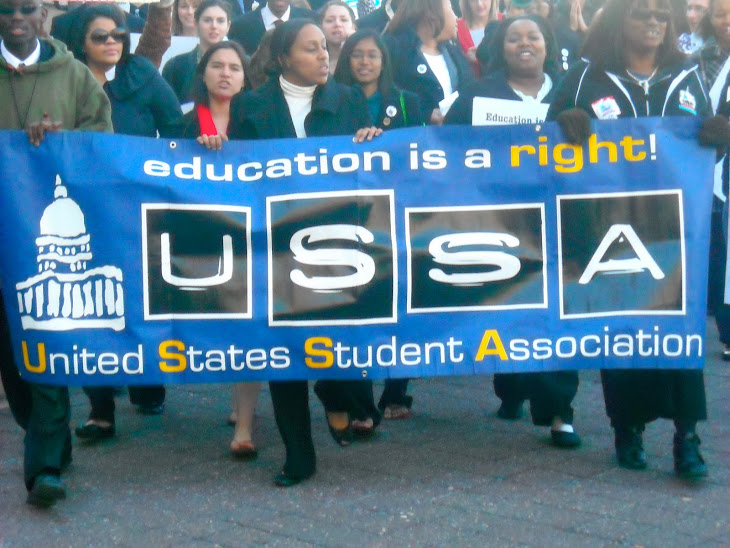
Jul 30, 2009
USSA Congress: Bittersweet goodbyes and new beginnings
Last week, student leaders from around the country convened in Boulder, Colorado for the 62nd annual National Student Congress. As time elapsed on the 2008-2009 leadership and board of directors, student delegates passed an ambitious agenda for the new academic year.
While the closing of Congress brought a rush of excitement about the new national legislative priorities and a renewed sense of community in the student movement, it was also a bittersweet moment as we said thanks to out-going president Carmen Berkley. During her tenure steering the USSA ship, Carmen oversaw membership growth, legislative victories, and was the literal voice of college students time and again. More importantly, Carmen has become an endearing friend to basically anyone who has been involved in the USSA in the past few years. On behalf of the USSA family, thank you Carmen for being a steady leader, caring friend, and all-around great person.
So it is with a nostalgic heart and energetic mind that the USSA turns to the future with new President Greg Cendana and Vice President Lindsay McCluskey. In their nomination speeches, both spoke about expanding membership to include more campuses in the student movement and utilizing student power to win concrete victories for higher education. Between the DREAM Act facing its best chance of passing yet and the Student Aid and Fiscal Responsibility Act overhauling a broken lending system, Cendana and McCluskey take the helm at a historic moment.
Thank you to everyone who participated in the 62nd annual National Student Congress- it was one of the best yet! Click here to watch speech highlights and read more about the conference.
While the closing of Congress brought a rush of excitement about the new national legislative priorities and a renewed sense of community in the student movement, it was also a bittersweet moment as we said thanks to out-going president Carmen Berkley. During her tenure steering the USSA ship, Carmen oversaw membership growth, legislative victories, and was the literal voice of college students time and again. More importantly, Carmen has become an endearing friend to basically anyone who has been involved in the USSA in the past few years. On behalf of the USSA family, thank you Carmen for being a steady leader, caring friend, and all-around great person.
So it is with a nostalgic heart and energetic mind that the USSA turns to the future with new President Greg Cendana and Vice President Lindsay McCluskey. In their nomination speeches, both spoke about expanding membership to include more campuses in the student movement and utilizing student power to win concrete victories for higher education. Between the DREAM Act facing its best chance of passing yet and the Student Aid and Fiscal Responsibility Act overhauling a broken lending system, Cendana and McCluskey take the helm at a historic moment.
Thank you to everyone who participated in the 62nd annual National Student Congress- it was one of the best yet! Click here to watch speech highlights and read more about the conference.
Jul 15, 2009
Students Thrilled with Student Aid Reform Bill
Today, the U.S. House of Representatives took a giant step forward in comprehensive student aid reform. The Student Aid and Fiscal Responsibility Act, introduced by Education Committee Chairman George Miller, invests billions of dollars in financial aid at no new expense to taxpayers. The United States Student Association, along with college students nationwide, is ecstatic about Congressman Miller’s unsurpassed commitment to higher education.
“With college students graduating tens of thousands of dollars in debt, now is the time for the government to revitalize its financial aid programs,” said USSA President Carmen Berkley. “The funding increases in this bill will directly affect many of the USSA’s 4.5 million members, along with millions of other low- and middle-income students across the county.”
Maximizing the Pell Grant is essential for the over 6 million college students who rely on these funds to stay in college. The bill increases the Pell’s maximum award amount to $5,550 in 2010, which is a great step in stabilizing this cornerstone of need-based aid. In addition, lowering interest rates on federally subsidized loans will lessen the financial burden for the 5.5 million low-income students who are forced to borrow these loans each year.
The USSA believes that education is right, not a privilege, and will be actively supporting this historic legislation as a means to help millions of students and potential students realize their dream of achieving a college degree.
“With college students graduating tens of thousands of dollars in debt, now is the time for the government to revitalize its financial aid programs,” said USSA President Carmen Berkley. “The funding increases in this bill will directly affect many of the USSA’s 4.5 million members, along with millions of other low- and middle-income students across the county.”
Maximizing the Pell Grant is essential for the over 6 million college students who rely on these funds to stay in college. The bill increases the Pell’s maximum award amount to $5,550 in 2010, which is a great step in stabilizing this cornerstone of need-based aid. In addition, lowering interest rates on federally subsidized loans will lessen the financial burden for the 5.5 million low-income students who are forced to borrow these loans each year.
The USSA believes that education is right, not a privilege, and will be actively supporting this historic legislation as a means to help millions of students and potential students realize their dream of achieving a college degree.
Jul 14, 2009
More reasons to end FFEL
Lately there has been a lot of talk about eliminating the public-private student loan partnership program known as FFEL (Federal Family Education Loan). The USSA stands firmly behind this objective, as the money saved from ending bank subsidies would help fund increases in the Pell grant.
There is, however, another reason why the FFEL program simply doesn't work: inefficiency brought on by an unnecessary middle man. See, while private banks provide loans, the money in administered by 35 guaranty agencies. While these agencies may have been helpful in the 1960s, when the federal government was new at financial aid distribution, decades of involvement by the U.S. Education Department has rendered them superfluous.
Additionally, the government curiously employs guaranty agencies to engage in two contradictory operations. First, the agencies receive fees for helping student borrowers avoid defaulting on their loans; second, they earn much larger fees if they collect borrowers' defaulted loans. In fact, last year these agencies received just $177 million for default aversion fees and a whopping $948 million for collecting defaulted loans. Not much incentive for the supposed neutral brokers to help students avoid defaulting on their loans...
This mandate is an egregious misuse of public funds, $1.57 billion in fiscal year 2008 specifically, aside from the fact that doesn't make sense to have these agencies carry out two fundamentally different tasks--and be paid for both!
This confusion and contradiction is just one more reason why President Obama's proposal to eliminate the FFEL program to further fund the Pell grant must become law.
You can read the New American Foundation's full report on this issue by clicking here.
There is, however, another reason why the FFEL program simply doesn't work: inefficiency brought on by an unnecessary middle man. See, while private banks provide loans, the money in administered by 35 guaranty agencies. While these agencies may have been helpful in the 1960s, when the federal government was new at financial aid distribution, decades of involvement by the U.S. Education Department has rendered them superfluous.
Additionally, the government curiously employs guaranty agencies to engage in two contradictory operations. First, the agencies receive fees for helping student borrowers avoid defaulting on their loans; second, they earn much larger fees if they collect borrowers' defaulted loans. In fact, last year these agencies received just $177 million for default aversion fees and a whopping $948 million for collecting defaulted loans. Not much incentive for the supposed neutral brokers to help students avoid defaulting on their loans...
This mandate is an egregious misuse of public funds, $1.57 billion in fiscal year 2008 specifically, aside from the fact that doesn't make sense to have these agencies carry out two fundamentally different tasks--and be paid for both!
This confusion and contradiction is just one more reason why President Obama's proposal to eliminate the FFEL program to further fund the Pell grant must become law.
You can read the New American Foundation's full report on this issue by clicking here.
Jul 13, 2009
Community Colleges are about to get a boost from the federal government
It's about time. During elections, politicians love to talk about how students are the future and education will solve all our social ills; yet, when an economic recession hits, tuition seems to be the first thing to skyrocket and financial aid the first thing to plummet. Not this time.
President Obama recently authored an opinion editorial in the Washington Post in which he reaffirmed his unprecedented commitment to the nation's community colleges. Community colleges, which were once the life-blood of job training and affordable vocation education, have been hit with massive budget cuts that adversely affect the poor and place-bound. President Obama's plan, due to be released later this week, may fund as much as $9 billion over 10 years to improve job preparation programs and create a $10 billion loan fund for community college facilities. Considering that the American Association of Community Colleges estimates $100 billion in needed facility repairs, this loan should be lent in the nick of time.
A major component of the plan could also be free online courses, owned by the government, with an emphasis on job creation and credit transferability. Coupled with expanded library services and laptop programs, free online courses would give thousands of low-income citizens access to a higher education.
Stay tuned for more coverage of this plan once President Obama releases the final version.
President Obama recently authored an opinion editorial in the Washington Post in which he reaffirmed his unprecedented commitment to the nation's community colleges. Community colleges, which were once the life-blood of job training and affordable vocation education, have been hit with massive budget cuts that adversely affect the poor and place-bound. President Obama's plan, due to be released later this week, may fund as much as $9 billion over 10 years to improve job preparation programs and create a $10 billion loan fund for community college facilities. Considering that the American Association of Community Colleges estimates $100 billion in needed facility repairs, this loan should be lent in the nick of time.
A major component of the plan could also be free online courses, owned by the government, with an emphasis on job creation and credit transferability. Coupled with expanded library services and laptop programs, free online courses would give thousands of low-income citizens access to a higher education.
Stay tuned for more coverage of this plan once President Obama releases the final version.
Jul 10, 2009
U.S. House of Representatives makes ciritcal investments in college students
This morning the U.S. House of Representatives subcommittee that oversees higher education appropriations released its 2010 budget proposal. The bill includes funding increases to critical financial aid and outreach and retention programs. The USSA applauds the subcommittee for making responsible, long-term investments in college students, which will ultimately help grow the nation’s economy and open the school doors to millions of potential students.
The increases include:
Click here to read more about the budget.
The increases include:
- The Pell grant, which will help 7.6 million low and middle income students afford college next year, had its maximum award amount set at $5,550, a $200 increase from 2009.
- Colleges and universities serving underrepresented communities received $653 million.
- The outreach and retention programs TRIO and GEAR UP were allocated $868 million and $330 million, respectively.
- 1.7 million disadvantaged and first generation students are slated to receive college preparation and support services.
Click here to read more about the budget.
Jul 9, 2009
Report finds what students already know- loan debt is out of control!
The Education Center recently released a report titled Drowning in Debt: The Emerging Student Loan Crisis. The study found what students already know all too well: college costs are skyrocketing. With tuition rates soaring and financial aid funding not keeping pace, more students are having to take out loans to pay for college.
In fact, about half of all students at four-year public universities are borrowing money for school, even with many colleges receiving government subsidies to control tuition hikes. This at a time when students' "unmet needs" (which is the difference between the total cost of college and the sum of the expected family contribution) has increased well beyond the maximum amount of money available from subsidized federal loan programs.
To fill this gap, multi-billion dollar private lenders have stepped in, offering high interest rate loans to students. Having little choice, students are taking the bait. During the 2003-04 school year, just 5% of undergraduates borrowed private loans; that number has since tripled to 14%.
Fortunately, there is hope. The Student Aid Reform bill, which is being drafted in the Education committee, would end the Federal Family Education Loan (FFEL) program, collecting $94 billion in savings to make the Pell grant an entitlement; expand the Perkins loan by $6 billion; and create an Access and Completion program with $2.5 billion funding over 5 years. The USSA is calling on congress to pass Student Aid Reform! This bill would mitigate the skyrocketing cost of college and help make a higher education a reality for many potential students.
Click here to read more about this legislation in the June legislative update.
- USSA
In fact, about half of all students at four-year public universities are borrowing money for school, even with many colleges receiving government subsidies to control tuition hikes. This at a time when students' "unmet needs" (which is the difference between the total cost of college and the sum of the expected family contribution) has increased well beyond the maximum amount of money available from subsidized federal loan programs.
To fill this gap, multi-billion dollar private lenders have stepped in, offering high interest rate loans to students. Having little choice, students are taking the bait. During the 2003-04 school year, just 5% of undergraduates borrowed private loans; that number has since tripled to 14%.
Fortunately, there is hope. The Student Aid Reform bill, which is being drafted in the Education committee, would end the Federal Family Education Loan (FFEL) program, collecting $94 billion in savings to make the Pell grant an entitlement; expand the Perkins loan by $6 billion; and create an Access and Completion program with $2.5 billion funding over 5 years. The USSA is calling on congress to pass Student Aid Reform! This bill would mitigate the skyrocketing cost of college and help make a higher education a reality for many potential students.
Click here to read more about this legislation in the June legislative update.
- USSA
Subscribe to:
Posts (Atom)