Aug 27, 2009

Senator Kennedy Leaves Legacy of Social Justice

Senator Edward Kennedy was a steadfast advocate for college students his entire career. The federal aid, access and retention programs, and anti-discrimination policies he championed for four decades has allowed millions of students to achieve a higher education. Specifically, his work in creating the Pell Grant enables millions of low-income students to go to college every year. By taking a leadership position in lowering the voting age to eighteen, Kennedy helped give political voice to millions of civically engaged young adults.

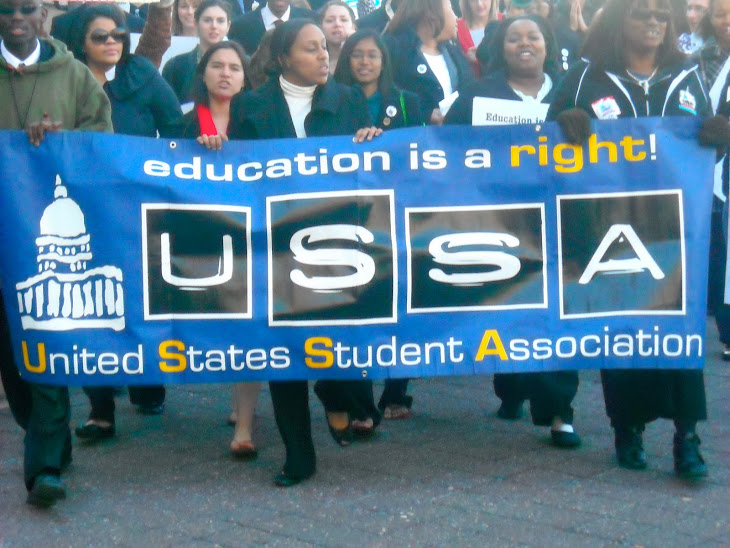
The United States Student Association and students across the country will look to the late senator for inspiration and wisdom in the continued pursuit to make education a right. Opening the college doors for those who cannot afford to pay the skyrocketing cost of a higher education is a noble way to remember Senator Kennedy.

LegCon Photo - Kennedy

While he will be sorely missed, Senator Kennedy will survive through the community organizing and political courage of those who carry the torch in making this a more just and compassionate world.


Aug 7, 2009

Baseless SAFRA pushback

The air seems particularly heavy with partisan ideology these days. Maybe it was Justice Sotomayor's confirmation hearing, perhaps healthcare reform, or even the renewed discussion on police/race relations. Regardless of its foundation, this political zealotry has begun seeping into the Student Aid and Fiscal Responsibility Act debate. Hopefully, when Congress returns from the August recess and assumes the SAFRA discourse, common sense will replace partisan entrenchment.

In response to the SAFRA's provision that eliminates the FFEL program and invests the $87 billion savings into the Pell grant, Congressman John Kline, the Ranking Republican on the House Education and Labor Committee, acrimoniously asked "is these any industry not on the verge of federalization?" Congressman Brett Guthrie is not "comfortable with the idea of the federal government acting as a profit-making bank."

Come on guys. Let's review the facts.

Sallie Mae, the country's largest private student loan company, has doubled its borrower-default rate since 2006 and overbilled the U.S. Treasury by $22.3 million from 2003-06. The guaranty agencies that administer these private loans received just $177 million for default aversion fees last year, versus $948 million for collecting defaulted loans! Not much incentive to help students pay off their debt with that financial schism. Conversely, the National Association of Student Financial Aid Administrators recently found that 61% of colleges that switched to the government's Direct Loan program found it less burdensome than FFEL and 80% made the switch within just four months.

So, if Congress makes the SAFRA debate about the most efficient way to administer student loans, rather than some abstract philosophy stalemate over federalism, it's clear that sticking to partisan bumper sticker lines isn't going to cut it.

Aug 4, 2009

Nonsense drug policy to be eliminated in SAFRA

Much of the debate over the Student Aid and Fiscal Responsibility Act has concerned the elimination of federal subsidies to private lenders and monumental funding increases to government aid programs. While these historic reforms are certainly receiving their due attention, one vital provision is being overlooked: Ending the policy of denying aid to drug possession convicts.

Currently, a student with a drug conviction, even as minor as a misdemeanor marijuana possession charge, is denied federal financial aid. This policy was slipped into the Higher Education Act reauthorization in 1998 by Representative Mark Souder of Indiana. Since its inception, 200,000 students have been denied aid because of this law and countless others have been deterred from even applying.

There are several reasons why this policy doesn't make sense. First, and most curiously, only students with drug convictions are denied aid under the law. Someone with a homicide conviction can be eligible for federal loans while someone with a marijuana possession charge is not. Second, this is the wrong way to be fighting our nation's drug problem. If a low-income student with a possession charge is denied the financial aid necessary to attend college, isn't it more likely he or she will slip back into the cycle of poverty and drug use that led to the conviction in the first place?

Supporters of the policy often talk about how attending drug rehabilitation programs will allow a convict to be eligible for aid. Taking this a step further, however, begs the question of can someone who can't afford tuition really pay for private rehab classes? In 2002, the Substance Abuse and Mental Health Services Administration concluded that the average cost for drug abuse treatment was $1,433 per course!

Lastly, not even the research arm of the federal government supports the policy. The congressionally-created Advisory Committee of Student Financial Assistance recommended that Congress remove the drug question from the FAFSA, calling it "irrelevant" to aid eligibility. Even the Government Accountability Office recently indicated that it could find no evidence that the penalty "actually helped to deter drug use."

It is time that Congress finally remove this unnecessary and nonsensical barrier to a college degree for those who need it most.