Sep 25, 2009

A United UC Community Marches in Solidarity


The presumption that college students have become lazy and apathetic was vigorously swept away in a tidal wave of student demonstrations against California's divestment in higher education yesterday. California students, in solidarity with faculty and staff, rallied and marched to voice their outrage over the skyrocketing cost of college, declining quality, furloughs, and pay cuts. UC Berkeley was the site for one of the largest protests since the historic free speech rallies in the 1960s, UC Irvine students ignored the near one hundred degree heat to turn out by the thousands, and hundreds of Bruins marched to the UCLA administration building to demand change.

The outpouring of protest was caused by the state and system's drastic higher education spending cuts and fee hikes. In July, the state legislature slashed three billion dollars from the state’s higher ed budget, causing the UC Regents to raise fees nine percent and cut three hundred million dollars. Then earlier this month, the UC Regents voted to increase tuition by thirty-two percent, bringing the cost of college up to ten thousand dollars. And it doesn't look like it's going to get better. According to the San Francisco Chronicle, the California regents are expected to raise tuition by forty-five percent next year, which would bring the grand total to $10,302.

Frustration reached a boiling point when neither the legislature nor the UC Regents accepted responsibility, each blaming the other for the financial crisis. "While we understand there's some anger and angst spread across our campuses, our hope is that it will be directed more precisely toward Sacramento [the state capital], where the heart of the problem lies," said UC's interim provost, Larry Pitts. Yet those in Sacramento are turning the issue back on the campuses, with Julia Brownley, chair of the Assembly Education Committee, saying "the state is facing an unprecedented fiscal crisis [and] the students are protesting how the university cut its budget. The Legislature left that up to the university." Meanwhile, as both higher ed governing entities point a finger at the other, and Governor Schwarzenegger dismisses the students as a "screaming interest group," the dream of a college education is slipping further away from thousands of potential students.

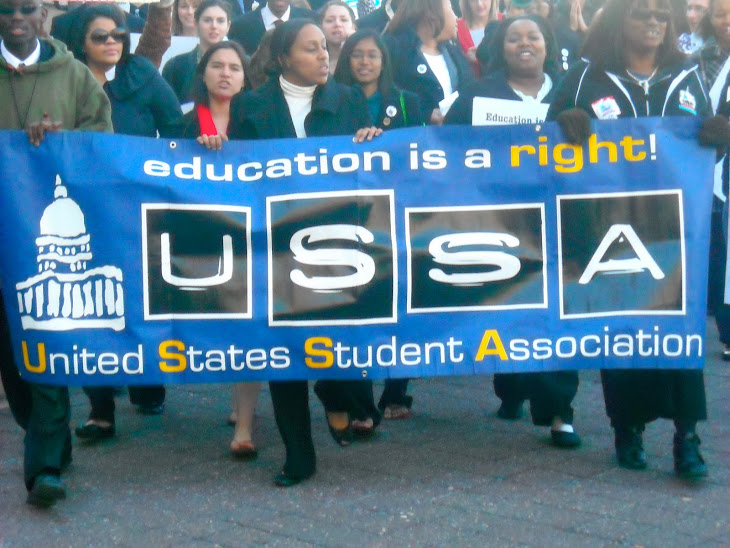
Yet despite the confusion of blame, and blazing heat, students, faculty, and staff refused to take the onslaught lying down. Raising signs that read "We Are UC," California students, faculty, and staff came together and with one voice showed the country that decision makers cannot ignore the collective power of thousands of community members directly impacted by the atrocious hikes in the cost of college. "This is a day of solidarity," said one Riverside student, indicating that while the demonstrations may have ended yesterday, the student movement across the nation will continue until education is again made a right.

Sep 17, 2009

U.S. House Passes Historic Student Aid Reform Bill

Today is a historic day for higher education as the U.S. House of Representatives passed the Student Aid and Fiscal Responsibility Act (SAFRA), H.R. 3221. The U.S. Student Association, along with students and families nationwide, are ecstatic about this landmark bill and its capacity to help millions of current and potential college students achieve an affordable and quality higher education. This legislation includes the greatest investments in higher education in American history.

SAFRA reforms the student loan industry by eliminating federal subsidies to private banks and investing the near one hundred billion dollars in savings into need-based aid programs. These investments in higher education surpass even the renowned G.I. Bill and Higher Education Act.

“On behalf of the USSA’s 4.5 million student members at over 400 campuses, we thank Members of the House of Representatives for their diligent work on passing SAFRA,” said USSA President Gregory Cendana. “Students today are taking on insurmountable amounts of debt to pay for college, essentially mortgaging their futures with convoluted loan plans from private banks. SAFRA will reform this broken system by increasing federal, need-based aid that will help bring President Obama’s goal to lead the world in college graduations to fruition.”

Additionally, SAFRA invests 2.55 billion dollars in Historically Black Colleges and Universities and other Minority Serving Institutions. “Increased funding for Minority Serving Institutions through this bill is a direct investment in communities traditionally barred from higher education and ensures greater access to the American dream,” said USSA People of African Decent caucus chair Getachew Kassa, a student at the University of Oregon.

The Senate is expected to take up its version of the student aid reform bill later this month. USSA students and staff will be organizing on campuses across the country to support the Senate bill and ensure that the crucial reforms in SAFRA reach President Obama’s desk by the end of the year.

Sep 16, 2009

USSA Joins Speaker Pelosi, Ed Secretary Duncan, Chair Miller, and others to Advocate for Student Aid Reform


On Tuesday, September 15, U.S. Education Secretary Arne Duncan, Speaker Nancy Pelosi, U.S. Rep. George Miller (D-CA), chair of the House Education and Labor Committee, other lawmakers and USSA students held two press events to urge the House to pass the Student Aid and Fiscal Responsibility Act (SAFRA), H.R. 3221, a bill which makes the largest investment in higher education in American history. The USSA membership voted overwhelmingly to support this historic legislation at the 2009 National Student Congress.

During the first press conference, surrounded by congressional leadership and the top higher education officials, USSA student Jelisa Difo, a Senior at the University of Massachusetts, Amherst, spoke about the necessity of student aid reform. “By investing in federal aid programs, SAFRA will ensure that millions of students like me have access to a quality and affordable higher education,” said Difo.

Immediately following the press conference, USSA President Gregory Cendana joined Secretary Duncan, Chair Miller, Rep. Tim Bishop (D-NY), and USSA student Michael Kebede from the University of Massachusetts, Amherst, to speak with student journalists and major media outlets about SAFRA.

“We are excited this monumental piece of legislation is moving in the House this week and are thankful we have education champions like Secretary Duncan, Chair Miller and Rep. Bishop fighting for students,” said Cendana. “USSA, along with students and families across the country, are thrilled about the investment SAFRA will put into higher education and the positive impact it will have on the economy.”

The House is expected to vote on SAFRA later this week. USSA students nationwide will continue to organize around supporting the legislation when it is taken up by the Senate.

Sep 14, 2009

College Affordability Spurs Economic Growth


At a recent event with Vice President Joe Biden, Treasury Secretary Tim Geithner reaffirmed his strong belief in the economic benefits of college affordability:

"College affordability is central to two key economic trends. Over the past generation, we have gone from a nation of savers to one of borrowers. We have devoted too many resources to consumption and not enough to investment. During this same period, we have also lost our global educational lead. While we once outpaced all other advanced economies in the percentage of our population that graduated from high school and college, much of the rest of the economically developed world has now caught up or surpassed us."

Secretary Geithner was speaking about 529 plans, education saving programs operated by states or educational institutions that help families set aside funds for future college costs. Washington State's GET (Guaranteed Education Tuition) program is an exemplary model of a 529, allowing parents to make tuition payments today so that they are protected from massive tuition hikes when their children attend college in ten or twelve years.

These programs are essential to college accessibility. To augment this point, the pervasively dire statistics respecting rising college costs are worth repeating. The average student borrower graduates over $20 thousand in debt, tuition hikes of 20-30 percent are a dime a dozen, textbook prices are quadruple the rate of inflation and cost an annual average just shy of $1 thousand, and books and supplies are now 10 percent of community college students' total budgets. The availability of 529 plans and other measures to hinder the skyrocketing cost of college, such as the Student Aid and Fiscal Responsibility Act, will help mitigate these financial barriers.

Equally ubiquitous are the benefits of a college degree, which are also worth reiterating. A college graduate, either 2- or 4-year, has much greater lifetime earnings than a high school grad, generating a larger tax base for public revenue and spurring economic growth through increased purchasing power. Crime and incarceration rates are significantly lower in highly educated communities, trends which are collaborated with drops in welfare dependency and health care needs. It seems like investment in college affordability programs is a near silver-bullet for many of the nation's domestic problems.

The U.S. House of Representatives will vote on the Student Aid and Fiscal Responsibility Act later this week, let's hope Members of Congress reach the same conclusion as Secretary Geithner and pass this historic piece of legislation.

Sep 8, 2009

The Responsibility of an Education

"Every single one of you has something you’re good at. Every single one of you has something to offer. And you have a responsibility to yourself to discover what that is. That’s the opportunity an education can provide," said President Obama in a speech to grade students as they head back to school this week. The tone of his speech was reminiscent of JFK's call to public service, a responsibility bore by each citizen derived simply from being an American. In today's case, the president challenged grade school students to make the most of their education by using their knowledge to serve their country.

Those fortunate enough to achieve a higher education have a similar charge to put their degrees' to use; however, there's a caveat. A K-12 education is guaranteed by the state, a higher education is not. Children and teenagers in this country are given an incredible opportunity to exercise their creativity in arts and literature, discover the vast and exciting world of science, and develop critical thinking and deductive reasoning skills through mathematics and social studies. Their worries are not how to finance their education, only how to best employ it. This needs to be the reality college students. If, as the president so ardently advocates, education is the key to our economic and social prosperity, then higher education must be made a right in this country.

There are two pieces of legislation currently in Congress that will bring this vision a bit closer to fruition. The Student Aid and Fiscal Responsibility Act (SAFRA) invests billions of dollars into Direct Loan programs such as the Pell grant, Perkins loan, and Work Study. These financial aid programs give students who might not otherwise have the opportunity to pursue a degree and better their lives. The DREAM Act affords undocumented students who currently to pay outrageous costs for college eligibility for federal financial aid. The aptly named bill will allow millions of hard-working students to realize their dream of a higher education in the land they've called home all their lives.

While President Obama's message was directed to adolescents, his vision for an education system limited only by the vigor and energy of its students can equally be shared by the college community. Let us not lose this opportunity to secure student aid reform, open the college doors to thousands of bright and capable undocumented students, and engage the political system like never before!

Sep 1, 2009

A dire outlook for young American workers

The AFL-CIO recently released a report detailing the plight of young American workers in today’s struggling economy. It should come as no surprise that the financial barriers facing young workers is having an adverse effect on their higher education attainment. Most notably, young people in the workforce are being forced to put their education on hold, delaying their achievement of financial independence. In fact, almost 40 percent of young workers have postponed college because of monetary issues. This number climbs even higher for young people of color.

The need for lending reform is clear, as the report found that nearly 1 in 4 young workers who take out loans for college end up dropping out. For these students to stay in school and better their lives, Congress must pass the Student Aid and Fiscal Responsibility Act, which will improve the federal lending system and invest heavily in critical retention programs.

The importance of a college education is illustrated in the daily struggles of young workers. Without a degree, young workers are much less likely than their college-educated peers to have enough money to pay the bills. This can lead to multiple jobs or plummeting further into debt.

All in all, the AFL-CIO report paints a bleak picture for America’s young workers without a college degree. Fortunately, President Obama has made higher education affordability a top priority for his administration. And with a strong commitment to community colleges and need-based aid from the federal government, hopefully the next report will shine a brighter light on the young American worker.