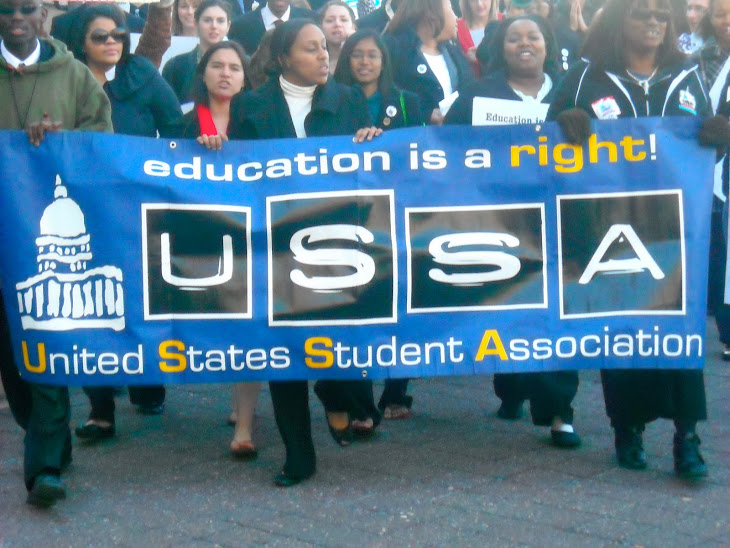
“Amidst chants of ‘We Shall Overcome,’ the University of California Board of Regents, except for the only voting student member Jesse Bernal, voted to increase student fees by 32 percent, or $2,500, yesterday at UCLA. This drastic increase triples the total cost of a UC education from a decade ago. The vote was met with a torrent of protest by those whom the decision directly affects. As an alumnus of UCLA and former board member of the University of California Student Association (UCSA), I was inspired by the coalition of students, faculty, and staff across the state who proclaimed to the nation that they would not accept divestment in higher education without a fight. The United States Student Association is in solidarity with the University of California Student Association, and all protesters, as they demonstrate the critical importance of student/worker solidarity in organizing against egregious fee hikes.
“While the increased cost presents an insurmountable barrier to college access for thousands of students and potential students, it’s only the tip of the iceberg. Nationwide, states are balancing budgets on the backs of students, slashing higher education funding and raising tuition and fees. Students need financial relief now more than ever, which is why the Senate must pass a companion bill to the Student Aid and Fiscal Responsibility Act (HR 3221). This bill makes the largest higher education investment in American history by eliminating wasteful government subsidies to banks and lenders and allocating the estimated $87 billion in savings over the next 10 years into low-interest, secure federal aid. USSA calls on Senators Harry Reid (D-NV) and Tom Harkin (D-IA) to take a leadership role in passing student aid reform.
“Reforming the loan industry will certainly help students, but this is an issue that runs deeper than financial aid. Yesterday’s vote is indicative of a larger culture in which higher education is viewed as little more than a bloated discretionary budget with distant payoffs, and students as perpetual revenue streams for deficit reduction. University leaders complain that state legislatures do not appropriate enough funds, lawmakers say tuition hikes are local decisions, and neither takes responsibility. Meanwhile, students drop out or are deterred from even applying to college and faculty and staff receive furloughs or get laid off. It is a vicious cycle that will cease only when we elect leaders who prioritize higher education in policy making, not just campaign speeches. Students must take the amazing vitality from protests and marches and direct that energy into passing student aid reform and electoral organizing. Although the 2010 election may seem distant, we need to begin organizing our peers to elect those who will legislate with the prudence to see past quick budget savings and make real investments in the country’s future.
“If California has taught us anything, it is that the amount of fee hikes states and regents will impose on students to mitigate budget shortfalls is limitless. It is time for a national student movement to elect a government that recognizes the lasting value of higher education and has the perseverance to legislate on those values, regardless of the economic or political climate.”
Nov 20, 2009
Nov 18, 2009
A Public Responsibility
There are a precious few moments when we have the opportunity to remake our national identity. Like the students who audaciously advanced civil rights in times of mindless violence, or the youth who rebuilt a nation devastated by the Great Depression, we now stand at the crux of fundamental change. It is in the midst of great upheaval that we are given the chance to define ourselves by the manner in which we respond to the immense challenges of the day. Higher education is the defining issue of our generation because on it relies the leaders and innovators on which all other fields of vital importance depend. We therefore have a responsibility to keep open the college doors for all.
Education is a right because everyone deserves the chance to reach their potential, regardless of income, identity, or citizenship. If people are allowed to pursue the best of themselves unrestrained by cost or frivolous restrictions, then society will benefit from their success. Accordingly, it is in the best interest of the government to enact policies that look beyond election cycles and slogans and invest in students.
The goal of making education a right is within our grasp. President Barack Obama has made it his administration’s goal to have the United States produce more college graduates than any other country by 2020. For this to happen, we, as students, must change the tone of higher education policy. Almost every state has balanced its budget by slashing higher education funding, raising tuition, and introducing more or higher fees. These policies are indicative of a political landscape in which higher education is viewed as little more than a bloated discretionary budget with distant payoffs, and students as perpetual revenue streams. While politically expedient, these policies are fiscally irresponsible in the long-run because they deny states the immense revenue generated by the higher taxable income and commercial spending of college graduates. Beyond that, the moral depravity of forcing students and families into severe debt paying for a public interest that should be a public responsibility is repulsive.
In Pittsburgh, Mayor Luke Ravenstahl has proposed a one percent tax on the “privilege of getting a higher education.” Under this plan, a Pennsylvanian undergraduate at the University of Pittsburgh would pay an additional 350 dollars a year simply because he or she chose to go to college. In New Mexico, Governor Bill Richardson signed a bill cutting 68 million dollars from the state’s College Affordability Fund. The governor did not cut funding for an off-roading safety program. The enormous tuition hikes in California prompted students at Berkeley to hold a mock funeral for the death of public education for minorities on the Day of the Dead. Elected officials may campaign on promises of change, hope, and the progress of underrepresented communities, but the recession has forced them to stand by their true priorities. Few are standing with students.
Our best chance for reforming higher education is in the U.S. Senate. In September, the House of Representatives passed the Student Aid and Fiscal Responsibility Act (HR 3221). This bill remedied the underlying flaw of the student loan industry by ending government subsidies to banks that offer federal student loans and allocating the estimated 87 billion dollars in savings into student-friendly financial aid programs. Despite commitments to prioritize higher education in the Senate, there has been no consideration of a companion bill. Young people have been demanding student aid reform decades. Regardless of how close we are to this historic measure, it will not come to fruition without the involvement of students.
States and localities have utterly failed to preserve college access and affordability amidst tough economic times. President Obama is ready to step up and sign a comprehensive student aid reform bill. We have a unique opportunity to take an unprecedented step forward in higher education. But the moment is brief and our leadership is required.
A college education should be a fundamental right not only because it makes economic sense, but because it is a moral imperative. As students, once again it is in our hands that the direction of the United States rests. We cannot let the tides of possibility recede between our fingers, too much is at stake. Write a letter to your senator urging student aid reform, submit an opinion editorial or letter-to-the-editor, sign up for news updates, or simply donate to the cause. Whatever the size of your contribution, you can be a part of the next great movement to make education a right!
Education is a right because everyone deserves the chance to reach their potential, regardless of income, identity, or citizenship. If people are allowed to pursue the best of themselves unrestrained by cost or frivolous restrictions, then society will benefit from their success. Accordingly, it is in the best interest of the government to enact policies that look beyond election cycles and slogans and invest in students.
The goal of making education a right is within our grasp. President Barack Obama has made it his administration’s goal to have the United States produce more college graduates than any other country by 2020. For this to happen, we, as students, must change the tone of higher education policy. Almost every state has balanced its budget by slashing higher education funding, raising tuition, and introducing more or higher fees. These policies are indicative of a political landscape in which higher education is viewed as little more than a bloated discretionary budget with distant payoffs, and students as perpetual revenue streams. While politically expedient, these policies are fiscally irresponsible in the long-run because they deny states the immense revenue generated by the higher taxable income and commercial spending of college graduates. Beyond that, the moral depravity of forcing students and families into severe debt paying for a public interest that should be a public responsibility is repulsive.
In Pittsburgh, Mayor Luke Ravenstahl has proposed a one percent tax on the “privilege of getting a higher education.” Under this plan, a Pennsylvanian undergraduate at the University of Pittsburgh would pay an additional 350 dollars a year simply because he or she chose to go to college. In New Mexico, Governor Bill Richardson signed a bill cutting 68 million dollars from the state’s College Affordability Fund. The governor did not cut funding for an off-roading safety program. The enormous tuition hikes in California prompted students at Berkeley to hold a mock funeral for the death of public education for minorities on the Day of the Dead. Elected officials may campaign on promises of change, hope, and the progress of underrepresented communities, but the recession has forced them to stand by their true priorities. Few are standing with students.
Our best chance for reforming higher education is in the U.S. Senate. In September, the House of Representatives passed the Student Aid and Fiscal Responsibility Act (HR 3221). This bill remedied the underlying flaw of the student loan industry by ending government subsidies to banks that offer federal student loans and allocating the estimated 87 billion dollars in savings into student-friendly financial aid programs. Despite commitments to prioritize higher education in the Senate, there has been no consideration of a companion bill. Young people have been demanding student aid reform decades. Regardless of how close we are to this historic measure, it will not come to fruition without the involvement of students.
States and localities have utterly failed to preserve college access and affordability amidst tough economic times. President Obama is ready to step up and sign a comprehensive student aid reform bill. We have a unique opportunity to take an unprecedented step forward in higher education. But the moment is brief and our leadership is required.
A college education should be a fundamental right not only because it makes economic sense, but because it is a moral imperative. As students, once again it is in our hands that the direction of the United States rests. We cannot let the tides of possibility recede between our fingers, too much is at stake. Write a letter to your senator urging student aid reform, submit an opinion editorial or letter-to-the-editor, sign up for news updates, or simply donate to the cause. Whatever the size of your contribution, you can be a part of the next great movement to make education a right!
Nov 17, 2009
Sweeping Resolutions Pass Student Senates
Earlier this month, the Associated Students of Portland State University adopted resolutions to support the USSA campaigns to pass the Student Aid and Fiscal Responsibility Act (SAFRA) and the Develop, Relief, and Education for Alien Minors (DREAM) Act. These resolutions, passed without objections by the student government Senate, show that Portland students are truly dedicated to making college a right for all. Additionally, the California State Student Association, representing 450,000 students in the California State University System, passed a resolution endorsing both SAFRA and the Private Student Loan Debt Swap Act of 2009 which allows students to exchange their private loans for direct loans. SAFRA was passed by the U.S. House of Representatives in September.
Portland's student aid resolution does more than simply support the legislation. Students called on Senators Ron Wyden and Jeff Merekly to vote for the Senate companion bill of SAFRA. Senator Merekly is critical for the bill's passage, as he is a member of the Health, Education, Labor, and Pension committee, the committee with jurisdiction over higher education reform. The California resolution points out the tremendous debt students are graduating with and the benefits of the direct loan program.
The DREAM Act resolution notes that the State of Oregon has both financial and altruistic interests in allowing undocumented students to have access to federal financial aid and a pathway towards citizenship. While there has been no movement on the bill since it's most recent introduction this past Spring, there is ample bipartisan support in both Chambers of Congress and President Obama has indicated he would sign the DREAM Act into law.
Student governments are passing similar resolutions across the country, amplifying the student voice in an effort to bring about vital higher education reforms.
Portland's student aid resolution does more than simply support the legislation. Students called on Senators Ron Wyden and Jeff Merekly to vote for the Senate companion bill of SAFRA. Senator Merekly is critical for the bill's passage, as he is a member of the Health, Education, Labor, and Pension committee, the committee with jurisdiction over higher education reform. The California resolution points out the tremendous debt students are graduating with and the benefits of the direct loan program.
The DREAM Act resolution notes that the State of Oregon has both financial and altruistic interests in allowing undocumented students to have access to federal financial aid and a pathway towards citizenship. While there has been no movement on the bill since it's most recent introduction this past Spring, there is ample bipartisan support in both Chambers of Congress and President Obama has indicated he would sign the DREAM Act into law.
Student governments are passing similar resolutions across the country, amplifying the student voice in an effort to bring about vital higher education reforms.
Nov 5, 2009
Young voters are more than a passing trend
What a difference a year makes. Leading up to the 2008 election, the youth vote was highlighted as the deciding bloc for a new America. This year however, media pundits and political insiders determined that youth were not going to be relevant in local elections, harping on it so much in the weeks preceding the election that it became a self-fulfilling prophecy.
Because youth weren’t supposed to be the deciding vote, candidates didn’t give young voters the same attention they did in 2008. In fact, many candidates and issue leaders barely even acknowledge youth voters in their campaigns. Hardly any candidate spoke about the historic student aid reform going through Congress, crippling state higher education budget cuts, or tuition hikes. In Virginia’s gubernatorial race, neither candidate spoke directly to youth or about youth issues during their respective campaigns until the eleventh hour. Yet youth were still expected to turnout in the same numbers that we did for President Obama, a candidate who made our generation a priority throughout his entire campaign.
Despite politicians’ disengagement with and the media’s skepticism of youth, students were incredibly active in the 2009 elections. In New Brunswick, New Jersey, the “Yes on Wards” campaign was developed and implemented largely by Rutgers’ University students. They successfully placed an initiative on the ballot to reform the city council to more accurately reflect the city’s population. Additionally, they registered hundreds of their peers to vote, educated the community on their issues, and ran a strong get-out-the-vote program. While media outlets were busy criticizing our apathy, students launched and directed a local campaign to reform city politics.
In Washington, voters were faced with a tax initiative that would link state spending to inflation and is widely seen as harmful to state services including higher education. To prevent this potentially catastrophic spending restriction, the Washington Student Association strongly opposed the initiative and organized to ensure its failure. In Oregon, students have registered almost five thousand voters since the academic year began in late September. Nationally, the United States Student Association (USSA) is hiring students for the 2010 election to empower their peers to run effective electoral campaign on campuses nationwide.
Youth are involved. Like any other demographic, we take action when candidates engage us and speak to our issues. We mobilize in large numbers when we believe our vote will make a difference. We are angry that big banks receive billions of dollars in government funds while we are graduating thousands of dollars in debt, if we graduate at all. We are tired of states balancing budgets on our backs. We are frustrated by the lack of movement on critical reforms in student aid, immigration, and healthcare. 2010 candidates should pay attention; youth voting didn’t begin with President Obama and it certainly didn’t end with his election.
Because youth weren’t supposed to be the deciding vote, candidates didn’t give young voters the same attention they did in 2008. In fact, many candidates and issue leaders barely even acknowledge youth voters in their campaigns. Hardly any candidate spoke about the historic student aid reform going through Congress, crippling state higher education budget cuts, or tuition hikes. In Virginia’s gubernatorial race, neither candidate spoke directly to youth or about youth issues during their respective campaigns until the eleventh hour. Yet youth were still expected to turnout in the same numbers that we did for President Obama, a candidate who made our generation a priority throughout his entire campaign.
Despite politicians’ disengagement with and the media’s skepticism of youth, students were incredibly active in the 2009 elections. In New Brunswick, New Jersey, the “Yes on Wards” campaign was developed and implemented largely by Rutgers’ University students. They successfully placed an initiative on the ballot to reform the city council to more accurately reflect the city’s population. Additionally, they registered hundreds of their peers to vote, educated the community on their issues, and ran a strong get-out-the-vote program. While media outlets were busy criticizing our apathy, students launched and directed a local campaign to reform city politics.
In Washington, voters were faced with a tax initiative that would link state spending to inflation and is widely seen as harmful to state services including higher education. To prevent this potentially catastrophic spending restriction, the Washington Student Association strongly opposed the initiative and organized to ensure its failure. In Oregon, students have registered almost five thousand voters since the academic year began in late September. Nationally, the United States Student Association (USSA) is hiring students for the 2010 election to empower their peers to run effective electoral campaign on campuses nationwide.
Youth are involved. Like any other demographic, we take action when candidates engage us and speak to our issues. We mobilize in large numbers when we believe our vote will make a difference. We are angry that big banks receive billions of dollars in government funds while we are graduating thousands of dollars in debt, if we graduate at all. We are tired of states balancing budgets on our backs. We are frustrated by the lack of movement on critical reforms in student aid, immigration, and healthcare. 2010 candidates should pay attention; youth voting didn’t begin with President Obama and it certainly didn’t end with his election.
Nov 4, 2009
Youth Report on Federal Initiatives at One Year Anniversary of Obama Election
One year ago, America’s youth overwhelming swept Barack Obama into office. Yesterday, leaders from a variety of youth organizations spoke with members of the press about what progress they feel President Obama and Congress are making on election promises to enact critical policy reforms. The press call happened in conjunction with the release of “One-Year Later,” a youth report on the federal government’s progress on a diverse range of subjects from healthcare to veteran affairs to higher education.
The United States Student Association (USSA) Vice President Lindsay McCluskey spoke about legislative efforts to pass student aid reform and the Development, Relief, and Education for Alien Minors (DREAM) Act. “The burden of paying for college has been passed on to students and working families, disproportionately impacting students of color, low income students, and students from other underrepresented communities,” said McCluskey. “However, President Obama and Congress have demonstrated a commitment to improving college access and affordability,” by passing the Student Aid and Fiscal Responsibility Act (H.R. 3221) in the House and expressing support for the DREAM Act.
While students remain optimistic about the DREAM Act’s eventual passage, its sluggish progression through Congress is denying thousands of students the chance to pursue a college degree and further contribute to the economy. Additionally, the Senate has yet to take action on its version of the Student Aid and Fiscal Responsibility Act, postponing critical increases in financial aid for students taking on massive loan debt and tuition hikes. The USSA and students nationwide will continue to advocate for these pieces of legislation until they are signed into law by President Obama.
The United States Student Association (USSA) Vice President Lindsay McCluskey spoke about legislative efforts to pass student aid reform and the Development, Relief, and Education for Alien Minors (DREAM) Act. “The burden of paying for college has been passed on to students and working families, disproportionately impacting students of color, low income students, and students from other underrepresented communities,” said McCluskey. “However, President Obama and Congress have demonstrated a commitment to improving college access and affordability,” by passing the Student Aid and Fiscal Responsibility Act (H.R. 3221) in the House and expressing support for the DREAM Act.
While students remain optimistic about the DREAM Act’s eventual passage, its sluggish progression through Congress is denying thousands of students the chance to pursue a college degree and further contribute to the economy. Additionally, the Senate has yet to take action on its version of the Student Aid and Fiscal Responsibility Act, postponing critical increases in financial aid for students taking on massive loan debt and tuition hikes. The USSA and students nationwide will continue to advocate for these pieces of legislation until they are signed into law by President Obama.
Subscribe to:
Posts (Atom)