May 25, 2010

USSA Board of Directors Opposes Controversial AZ Laws

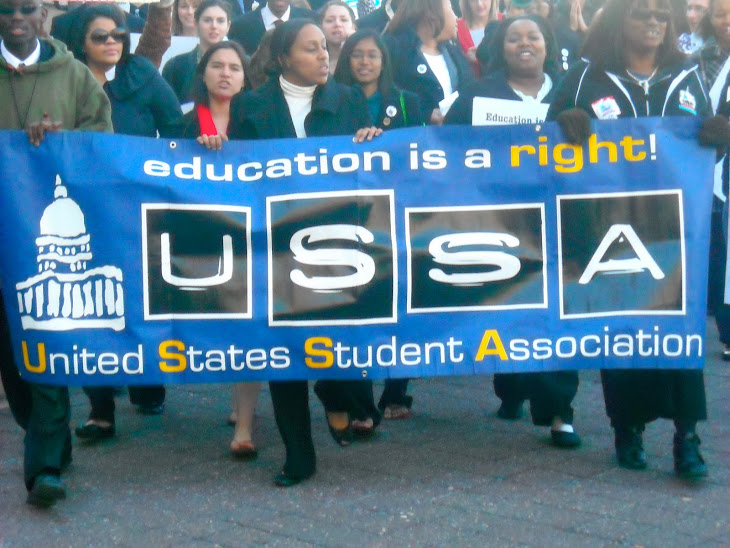
During their spring meeting, the United States Student Association (USSA) Board of Directors passed a resolution condemning three recently enacted Arizona laws. In response to the resolution, USSA President Gregory Cendana issued the following statement:

“The United States Student Association’s (USSA) vision is to help engender a just society in which social change is created through an empowered and diverse youth community. In keeping with this vision, the USSA Board of Directors recently passed a resolution opposing three Arizona laws repugnant to a just society.

The first law, SB 1070, requires Arizonan immigrants to carry their registration documents at all times and gives police broad power to detain anyone suspected of illegal immigration. The policy codifies racial profiling, making many Arizonans suddenly and without cause suspects of illegal immigration. The legislation has inspired other state legislatures to begin crafting similar laws, making this a national issue requiring a national response. As the oldest and largest national student organization, USSA has a responsibility to stand against this law and others like it.

SB 1070 is also bad higher education public policy. President Shelton of the University of Arizona stated that, ‘the families of a number of out-of-state students have told [the university] that they are changing their plans and will be sending their children to universities in other states.’ USSA will not support, and will indeed oppose, laws that discourage college attendance. What’s more, the law creates an unfunded mandate at a time when the state and nation are suffering recessions of historic proportions. The cost of policing, detaining, trying, and deporting suspected undocumented immigrants will be vast and may result in further cuts to higher education.

Second, HB 2382/ SB 1097 requires public school teachers to report undocumented students to Arizona’s Department of Education. Even if they are undocumented, the U.S. Supreme Court has ruled that they are still entitled to certain inalienable rights that cannot be violated by Arizona, including the right to a K-12 education.

Along with SB 1070, this law threatens the rich diversity so long enjoyed by Arizona’s early and secondary schools. In addition, these laws will result in families that have both citizen and undocumented children weighing the benefits of enrolling a child in school against the potential threat of being discovered and deported. No family should be forced into a dilemma that contradicts USSA’s principle that an education is a right not to be conditioned upon one’s immigration status.

Third, HB 2281 forbids the teaching of ethnic studies programs that are perceived by the state superintendent to ‘galvanize ethnic solidarity.’ In defense of this law, Arizona Superintendent and candidate for state Attorney General Tom Horne has made the argument that if students learn about ethnic cultures, histories, and literature, then they will cease to treat others as individuals. The logic jump from ethnic education to anti-individualism is baseless and without an iota of evidence. WE must be able to learn, understand, and appreciate our diverse backgrounds and stories in order to celebrate diversity as a community and work towards a just society.

The Arizona anti-immigrant laws were passed in a vacuum of non-existent federal action, making their proliferation in border and high-immigrant populated states likely and USSA’s action necessary. Therefore, USSA calls for a comprehensive, national solution, beginning with the passage of the Development, Relief, and Education for Alien Minors (DREAM) Act this year.

It has been said that America’s youth is its conscience. In that light, as the oldest and largest student organization, with a proud history of inclusion, diversity, and tolerance, the United States Student Association unequivocally opposes these laws as unjust infringements on the human and civil rights of Arizonans.”

May 19, 2010

In loving memory of Tam Tran and Cinthya Felix

We are deeply saddened by the passing of Tam Tran and Cinthya Felix, two beloved champions for social justice who tragically passed away in Maine last Saturday. They were tireless advocates for the DREAM Act, federal legislation that would provide a higher education and pathway to citizenship for many of the nation’s best and brightest undocumented students.

Tam was featured in and helped produce the DREAM Act documentary Underground Undergrads: UCLA Undocumented Immigrant Students Speak Out. Additionally, she testified before Congress in 2007 on the need for the DREAM Act. As a leader in Improving Dreams, Equality, Access and Success (IDEAS) at the University of California, Los Angeles, Tam helped push USSA towards being a more active supporter of the DREAM Act.

USSA honors and celebrates the lives of these two amazing DREAMers and our thoughts are with their friends and families. Tam and Cinthya will live on in the selfless and courageous organizing by undocumented and documented students alike on behalf of the DREAM Act and broader immigrant justice.

Donate to Tam and Cinthya’s Memorial Funds:

Tam was born in Germany after her parents were forced to flee Vietnam. She immigrated to the U.S. and grew up in Garden Grove, California. She graduated from Santiago High School, attended Santa Ana College, and transferred to UCLA, where she earned a bachelor's degree in American Literature and Culture. In 2007, Tam testified before a House subcommittee on immigration and advocated on behalf of the proposed Development, Relief and Education for Alien Minors (DREAM) Act. As a doctoral student in the American Civilization program at Brown University, she helped found the Brown Immigrants' Rights Coalition. Tam was an aspiring filmmaker, and produced several short films, including the acclaimed documentary, "Lost and Found."

Cinthya emigrated from Mexico and grew up in East Los Angeles, California where she attended and graduated from Garfield High School. She pursued higher education at UCLA, where she earned bachelor's degrees in English World Literature and Spanish Literature, with a minor in Mexican Studies. At UCLA, Cinthya was a founding member of Improving Dreams, Equality, Access and Success (IDEAS), one of the nation's first and largest undocumented student advocacy groups. In 2007, she became the first undocumented student admitted to Columbia University's School of Public Health. Cinthya's dream was to attend medical school and eventually return to her community as a physician.

May 17, 2010

In Solidarity with Puerto Rico Students

For those who question the vigor of today’s college student activists, I refer you to the University of Puerto Rico.

After cuts of 100 million dollars to the university budget, leading to massive increases in tuition, cuts to financial aid, and staff layoffs, the General Council of Students began a strike that has lasted over three weeks and mobilized thousands of students. Economists estimate the strike has cost the institution, which serve 65 thousand students at 11 campuses across the island, anywhere from one to 52 million dollars. The students are demanding a four percent tuition cap, a policy that was commonplace in the states until the recent fiscal crises.

The United States Student Association (USSA) stands in solidarity with our brothers and sisters in the General Council of Students at the University of Puerto Rico. Despite police blocking the delivery of food, the students continue to stand against unjust budget policies that keep a higher education out of reach for the disadvantaged and even middle-class.

Too often, higher education decisions by political and administrative leaders are made without consideration from those whom are directly affected by their outcome: students. When these decisions become so egregious that they bring down the quality, affordability, and accessibility of a higher education, it is the responsibility of students to take action. The protests have been civil, non-violent, and effective; a model in civil disobedience that the USSA applauds.

USSA hopes for a peaceful outcome to the protest and urges the administrators to accept the reasonable four percent tuition cap demanded by the students.

May 13, 2010

Students and Young Adults Hit Hard by Financial Crisis

Young Americans face “lasting damage” from the dual crises in the financial sector and in personal finance, making it urgent that Congress pass strong financial reform legislation.

Risking Our Future Middle Class: Young Americans Need Financial Reform, released on Thursday by three leading youth advocacy organizations – the United States Student Association, U. S. Public Interest Research Group, and Demos – documents how hard youth have been hit by the country’s economic crisis.
  • Young people (16-24 year-olds) have higher unemployment rates than any other population group,
  • Programs have been cut, or tuitions increased, or both, at most of the country’s public colleges and universities.
  • Young Americans have high levels of indebtedness due to private student loans, credit card balances, mortgages and car loans.
Risking Our Future Middle Class makes it abundantly clear of the urgency for the Senate to pass the America's Restoring Financial Stability Act, S. 3217, now under consideration by the Senate. Among other things, the legislation would establish an independent Consumer Financial Protection Bureau (CFPB), regulate derivatives and other shadow markets, end the too-big-to-fail regime and provide other safeguards following the world's greatest financial meltdown since the Great Depression of 1929.

“From credit cards to private student loans, we’ve been aggressively targeted by abundant but risky credit,” explained Andrew Merki, a junior at the University of Indiana at Bloomington and the chair of the Indiana PIRG, a member of U.S. PIRG. “The tens of thousands of dollars in high interest loans I’ll have to repay at graduation will benefit the banks, but keep me in a financial hole.”

“This is a generation of 18 – 29 year olds unemployed or involuntarily out of the workforce,” added Gregory Cendana, President of the United States Student Association. “With jobs scarce, higher education should be an accessible training ground, but instead it is under siege.”

Risking Our Future Middle Class documents that debt has become a generation defining characteristic for today’s young adults. For instance, private student loans typically have uncapped, variable interest rates reaching as high as 18% in recent years, and they cannot be deferred in the event of job loss.

“Young adults need tools to save and build assets for the future, otherwise they’ll be dragged down by a predatory financial market,” noted Caleb Gibson of Demos. “We need more disclosure, fair pricing, and protection from the excessive risk taking of banks.”

Senator Dick Durbin (D-IL) recently sponsored an amendment to the Wall Street reform package that would ensure that private loans from the country’s largest student lender, Sallie Mae, fall under the CFPB’s authority. “Too often, students, who don’t realize the long-term impact of their loan decisions, fall victim to high interest rates and predatory lending. We owe it to them and their families to make sure higher education remains accessible by putting strong protections in place that prevent abusive practices in private student lending.”

Similar legislation passed the House in December. According to Americans for Financial Reform, a coalition of more than 250 reform organizations including U.S. PIRG, USSA, and Demos, industry opponents of the strongest parts of the reform package have been spending almost $1.4 million a day since the beginning of 2009 in an attempt to weaken the pending legislation through special interest carve-outs and weakening amendments.

May 8, 2010

As the temperature rises, we must turn up the heat for the DREAM Act

By Gregory Cendana, USSA President

Just one week ago on May 1, I decided to participate in a civil disobedience on International Worker’s Day. In line with the celebration of the social and economic achievements of the international labor movement, it was a day to uplift the continuous struggle of immigrants, especially youth, in the United States. Joining other youth and immigration advocates, 35 of us risked arrest by sitting in front of the White House with letters that spelled the phrase: “Obama, Stop Deporting our Families.” There was a need to send a strong message: Lawmakers hungry for our votes must take swift action now because it in the right thing to do!

This decision was also very personal. As someone who comes from an immigrant and union family, risking arrest is very personal and comes from the foundation my family has built for me. My parents immigrated here decades ago in search of greener pastures and to live the American life that was only dreamt about in the Philippines. They are some of the hardest working people I know but still struggle to pay their mortgage, keep food on the table and support my sister who is a full time student at Sacramento State University. Not to mention, helping pay off my more than $40,000 in loan and credit card debt after graduating from UCLA.

I was also inspired to take action by some close friends who happen to be undocumented youth, a group who usually gets left out of the debate. It reminds of a documentary I saw, where someone who gave their testimonial described the yellow signs you find close to the California & Mexico borders where a younger person is being brought along with their family. What about them?

While attending UCLA, I got to know some of the best and brightest students who are the current and future leaders of our country. I have been humbled by their tenacity and courage to keep fighting despite years of inaction from Congress and the White House to provide them with a pathway to citizenship through higher education or to prevent separation from their families. Matias Ramos & Fabiola are two of these people who I love dearly and who continue to inspire me each and every day.

My participation in this civil disobedience was also a realization that as a US citizen and someone who has the privilege of not thinking about if the Immigration Customs Enforcement (ICE) is going to raid my house, that I have a responsibility as an ally to help spread the word about the struggle of undocumented youth and the importance of the passage of the Federal DREAM Act. Many, like Matias & Fabiola, were brought here when they were young and know the United States as their home. In fact, they have become prominent leaders in their communities and continue to be inspiration to thousands across the country.

Enough is enough and action is necessary now. Part of my decision to participate in the civil disobedience also comes at the cusp of the passage of Arizona Senate Bill 1070. This legislation shows that the country is in need of practical solutions. The good news is that after almost a decade of organizing and advocacy on the DREAM Act, we are the closest we have ever been. We cannot stop now. Arizona families and frankly, all of us across the country, should be ashamed and hope this type of legislation does not pass elsewhere.

As a recent graduate myself, I know that we must be students first. School is starting to get out for some and some are currently in the midst of finals as we speak. As students continue to be studying or hard at work trying to pay off their tuition, President Obama and Congress have yet to take action on the Federal DREAM Act.

Each day, many undocumented students are barred access to education and are left in limbo with no options to better their lives. As we get closer to the 2010 election day, our timeline for seeing passage of such critical legislation is shortening. By participating in the action on May 1, we took critical steps forward to escalate our campaign. How hungry are you for the passage the DREAM Act? What are you willing to put on the line? I ask that you join me as we turn up the heat for the DREAM Act!

We understand that standard DC beltway thinking is to not tackle “real issues” during an election year. But the Surge voter is different. Youth voters need to be inspired and motivated by real action on our issues—policy victories that demonstrate the impact of voting. Let me be clear and say that the passage of the Student Aid & Fiscal Responsibility was a huge victory, but simply not enough.

Young “surge” voters were a huge factor in both 2006 and 2008 elections. Research shows that first time voters’ next election determines lifetime engagement: Vote in consecutive elections, and that voter becomes a lifetime voter. With millions of surge voters, 2010 will determine the health of our democracy for a generation.

It is critical that we move forward as a nation and recognize the positive social and economic impacts of an educated workforce and legislate accordingly. Pass the DREAM Act Now! A dream deferred, is a dream denied.

"Students around the world have been at the forefront of movements to promote democracy and human rights. Student movements have toppled powerful dictatorships and military juntas. Student movements have ended wars. And student activism has often served as the conscience for nations, reminding people in times of turmoil of the founding ideals of their countries and the aspirations of all people for justice, dignity, and equality."

-Glenn Omatsu

If we don't act, then who will?