Jul 29, 2010

Students set new tone, leadership for the student movement

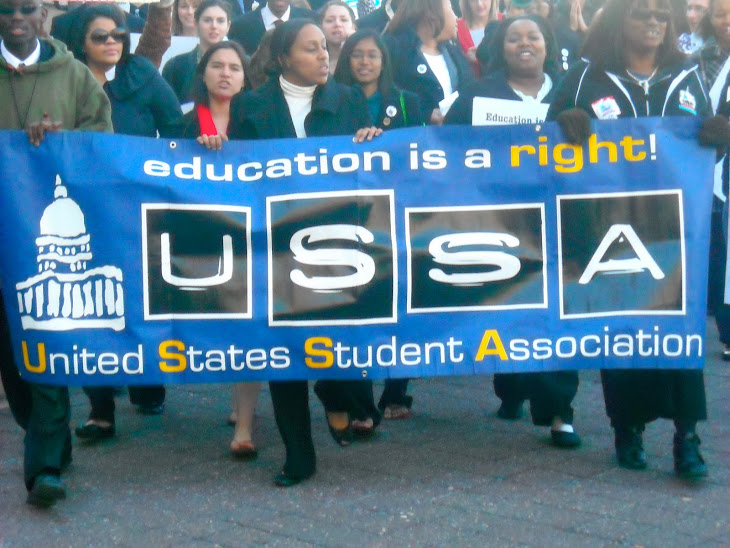
Nearly 200 college student organizers and leaders assembled at the University of California, Los Angeles last week for the United States Student Association’s (USSA) 63rd annual National Student Congress.  Members of the nation’s oldest, largest, and most inclusive student organization met to elect the 2010 – 2011 USSA President and Vice President, Board of Directors, and pass the national agenda for students.

Lindsay McCluskey, the previous USSA Vice President and University of Massachusetts, Amherst graduate, was elected President of the organization. “I’m honored and excited to be in this role at a time when momentum is building in the student movement,” said McCluskey.  “It’s a critical time for students to be engaged in the midterm election, fighting back against severe budget cuts and tuition hikes, and defending their right to a higher education.”  Victor Sanchez, a recent graduate of the University of California, Santa Cruz and outgoing President of the University of California Student Association, was elected Vice President.   "The real work starts now,” said Sanchez.  “I'm excited and ready to help build the student movement from coast to coast and make sure education is a right and not a privilege."

Top action agenda items to be taken up this year by USSA are passage of the Development, Relief, and Education for Alien Minors (DREAM) Act, federal jobs legislation to mitigate historic youth unemployment, voter work for the 2010 mid-term elections, and student advocacy in the federal budget and appropriations process. 

The 2010 – 2011 Board of Directors met for the first time after the conference, setting the tone for the upcoming academic year and beyond.  “Sitting on the USSA board of directors with students across the United States is going to be a powerful experience” said National People of Color Student Coalition chair Tiffany Loftin, a student at the University of California, Santa Cruz.  “I look forward to the nation's reaction to our movement, because we are driven by our testimonies and empowered by each other.”

The next national conference held by USSA will be the 42nd annual Grassroots Legislative Conference and National Student Lobby Day March 19-22, 2011 in Washington, DC.

Jul 28, 2010

Students Respond to Passage of Financial Reform

The financial collapse of 2008 had rippling effects across America, including on college students. Young people, who were already victim to decades of higher education divestment, saw higher education budgets slashed by state legislatures and tuition and fees soar.  With these higher costs and dwindling financial aid, student debt has risen to nearly $25,000 for the average borrower.   The federal government took steps to mitigate these financial burdens by passing historic student aid reform last spring, ushering in a new era of federal investment in college students.  Private lenders, however, still needed strengthened regulation.

 The recently signed financial reform legislation does just that.  The bill creates the Consumer Financial Protection Bureau (CFPB), the first federal agency completely devoted to guarding consumers against dangerous lending practices.  The Bureau’s authority over private student loans will help reign in the ‘wild west’ of student lending.  However, the CFBP is limited to overseeing banks and credit unions making over $10 billion; Sallie Mae Bank, the nation’s largest student lender, makes $5 billion and will escape the agency’s supervision.  Students fought hard to end federal subsidies to private lenders because their lending practices lead to massive student debt; Congress shouldn’t allow that progress to retreat by diluting the CFPB’s authority.

USSA supports the independence of the CFPB as a neutral, objective watchdog, keeping solely the interests of American consumers, including college students, in mind.

Additionally, the final version of the bill does not include the House of Representative’s provision requiring students be made aware of any federal loans for which they are eligible before taking out private loans.  This policy is critical because, according to the U.S. Education Department, nearly two-thirds of undergraduates who borrowed private loans in the 2007-2008 academic year did so despite being eligible for lower-cost federal loans, and one quarter of these students did not take out any federal loans at all.  More awareness of federal loan eligibility is critical to the effectiveness of college affordability policy.

 USSA applauds Congress for taking the difficult but necessary steps to reform the nation’s financial framework.  Students will be working to ensure the CFBP vigilantly guards students against the predatory practices of private lenders.

Jul 7, 2010

Students Call for Passage of Financial Reform Legislation in the Senate with Stronger Consumer Financial Protection Bureau

The United States Student Association (USSA), representing over four million college and university students nationwide, applauds Senator Chris Dodd, Representative Barney Frank, and all those who having worked diligently on the historic Wall Street Reform and Consumer Protection Act.  Members of Congress have recognized the importance of including regulation over private loans, the ‘wild west’ of student lending, in their efforts to stabilize the nation’s financial framework.

Unprecedented divestment from higher education has forced a third of students to borrow loans to pay for college, leading to nearly $25,000 of debt for the average graduate borrower.  Private lenders have taken advantage of this situation by imposing rigid repayment plans and excessive and arbitrary interest rate hikes on students.  The Consumer Financial Protection Bureau’s (CFPB) authority over all private student loans is a giant step in the right direction.  USSA further commends the private student loan ombudsman, which will drastically improve the student loan system through assistants to borrowers and constructive policy analysis.

In addition to these provisions, USSA calls for CFBP regulatory power over banks making under $10 billion.  Without this authority, Sallie Mae Bank, the largest private loan lender in the nation, will escape from under the watchful eye of the CFPB.  During the recent student aid reform debates, lending practices by Sallie Mae and banks like it were brought to light that demand more rigorous federal regulation.  It would be counterintuitive to end the Federal Family Education Loan program, due in large part to the lending practices of Sallie Mae, only to then remove Sallie Mae bank from CFPB oversight.

Additionally, USSA calls for a reinstatement of the House of Representative’s provision requiring students be made aware of any federal loans for which they are eligible before taking out private loans.  Nearly two-thirds of undergraduates who borrowed private loans in the 2007-08 academic year did so despite being eligible for lower-cost federal loans, and one quarter of these students did not take out any federal loans at all.  More awareness of federal loan eligibility is essential for effective college affordability legislation.

Not since President Roosevelt’s New Deal has Congress undertook such an ambitious and important reform of our nation’s financial system.  Instrumental in that reform is the protection of consumers against unscrupulous lenders, something that each student has a vested interest in.  During the Independence Day recess, students are taking action in-district on this legislation, letting their senators know why financial reform is critical to college affordability.  USSA urges the Senate to swiftly pass the Wall Street Reform and Consumer Protection Act with a strengthened CFPB.

Jul 2, 2010

Students React to President Obama’s Immigration Reform Speech with a Call for Passage of the DREAM Act

"We can be a nation of laws and immigrations," declared President Obama at yesterday’s immigration reform speech.  He spoke of America attracting the best and the brightest from across the globe and the moral imperative to fix our broken immigration system.  While the numerous issues hindering immigration reform were eloquently outlined, the president’s speech lacked an action plan for enacting reform legislation.  The conspicuous absence of a legislative strategy was disappointing, and the reality is setting in that comprehensive immigration reform will most likely not happen this summer.

Despite the political posturing that has stalled the immigration debate, the Development, Relief, and Education for Alien Minors (DREAM) Act has attracted massive public and legislative support.  Passing the DREAM Act as a stand-alone bill not only makes sense, it’s what the nation is demanding.

Undocumented youth and their allies are being arrested, hospitalized, and harassed as they fight for the DREAM Act.  Undeterred by threats or legislative lethargy, these activists continue to demonstrate that while Congress may not have an appetite for larger immigration reform, America is hungry for the DREAM Act.  Grassroots organizing for the DREAM Act on campuses and in communities across the country has made clear that creating a pathway to citizenship through education for undocumented youth is something most of us can agree on.

This support is also reflected in Congress.  The DREAM Act has 124 co-sponsors in the House of Representatives and 40 in the Senate, unbelievably high numbers considering the partisanism of Capital Hill.  The fact that almost a majority of Senators not only support the bill, but have put their name to it demonstrates the immense common sense popularity of the DREAM Act.

Representing over four million college students, the United States Student Association calls on Congress to pass the DREAM Act as a stand alone bill this summer.  It is a common sense solution to immigration that has both legislative a public support.  It’s time for a reality check.  There is no reason to continue holding out for future comprehensive immigration reform that may or may not happen while DREAM Act qualified undocumented students are being deported right now.  Congress must put politics aside and do what is right—pass the DREAM Act now!

Jul 1, 2010

Is College only for the Rich?

Chief among America's most revered ideals is that an education can propel anyone from the depths of destitution to the skies of achievement. This, along with socioeconomic reason, is why President Obama boldly announced in his first State of the Union address that the United States would once again lead the world in college graduation rates by 2020. Only three months later, the president took a major step forward in meeting this goal by signing historic student aid reform into law, investing about $40 billion in need-based federal financial aid over the next decade. The Georgetown Center for Education and Workforce recently concluded that the president's goal will require about $110 billion more from state governments, an unlikely feet considering over 30 states are implementing higher education budget cuts next fiscal year.

For the sake of argument, let's assume this goal is met, and more young people strut across American college graduation stages than anywhere else in the world. We still have to ask, who are these graduates?

The Advisory Committee on Student Financial Assistance recently found that, even with recent federal investments in financial aid, it is getting harder for low-income students to attend and graduate from college. In its most recent report, "The Rising Price of Inequality," the committee found that an increasing number of low-income students, who are academically qualified to attend college, are prevented from enrolling due to ballooning costs and insufficient grant aid. For a country that prides itself on merit-based success, this is unacceptable.

The report begins by emphasizing

    "our financial aid system is founded on the principle that any youth, regardless of family income, should have the financial opportunity to do so, if he or she has the aspiration and prepares adequately."

Based on this principle, we are failing. Between 1992-2004, initial enrollment rates of academically qualified low-income high school graduates in four-year colleges dropped from 54 percent to 40 percent. Instead, they are beginning college at two-year institutions where they are over three times less likely to earn a bachelor's degree than their peers who began at four-year institutions. Based on this enrollment shift away from four-year colleges, the percentage of low-income students who earn bachelor's degrees will drop from 38 percent for those who graduated from high school in 1992 to 31 percent of those who graduate in 2004.

The cause of this drop, the committee found, was concerns about college expenses and insufficient financial aid. From 1992-2007, the net price of a four-year public college went from 41 percent of a low-income family's annual income to 48 percent. That was before the financial meltdown and subsequent explosion of unemployment. Grant aid is not keeping up. The Pell Grant, the cornerstone of need-based federal aid, has seen its purchasing power plummet nearly 40 percent since it was created. State need-based aid has fallen victim to budget cuts as well.

All of these causes and effects of massive education divestment are leading to a university reality in which degree attainment is based not on intellect or determination, but on affluence. The rich are going to college; the poor are being left behind. Despite the federal government's recent action around student aid reform, this situation will not change unless state governments stop using higher education budgets as their chopping blocks for deficit reduction. Even if it is not constitutionally mandated for a state to fund higher education, legislators have a duty to ensure their citizens are provided an opportunity to better themselves through a college degree regardless of income. At the very least it is sound, long-term fiscal policy to invest in college graduation rates.

The federal government isn't completely blameless either. Because the Pell Grant program is a discretionary spending item, Congress is under no obligation to provide it with funding. Therefore, year after year, it relies on the political sympathy of appropriators and budgetary breadcrumbs of "more important" spending items such as national defense. This year, to fill a $5.7 billion shortfall, Congress is proposing to fund the Pell Grant through a bill financing war operations in Afghanistan. Is this really what it has come to? The United States government has so little investment in low-income students attending college it has to rely on a war spending bill to fund the most basic need-based grant program? We can do better than this.

Not only are low-income Americans being kept out of college, they are being prevented from entering the middle class because of this exclusion. In 1970, 26 percent of the American middle class had a post-secondary degree; today that number has jumped to 61 percent. 91 million jobs in 2007 required at least some college education. A college education is a must for low-income Americans to break into the middle-class.

The United States Student Association praises President Obama's goal of having the United States leading the world in college graduation rates by 2020. However, we need to be mindful of who those graduates will be and vigilantly guard against policies that keep low-income, academically qualified high school graduates out of college. Education is right and if an individual works hard, as our financial aid system was built to ensure, that person deserves a chance to earn a college degree.