
President Obama has set a noble goal of having the United States lead the world in college graduation rates by 2020. It is an aim that will empower individuals and strengthen the country as a whole, but it certainly won't be easy. Our current graduation rates are far behind our international competitors and we will be hard pressed to meet our own college-educated workforce capacity by the end of the decade. However, a united education community that invests in college access, degree quality, and workforce readiness will no doubt succeed in this effort. It will take us all, public and private four-year institutions, community and technical colleges, trade schools, and for-profit career colleges to once again place the United States paramount in education.
This also means we have to hold all members of this education community accountable. For-profit colleges play a key role in America's higher education system. They serve many low-income, non-traditional, and traditionally underrepresented students in flexible ways that provide alternatives to traditional post-secondary education. As a result, a substantial amount of federal student aid goes to these institutions, both through aid recipients choosing to attend for-profit colleges and through government subsidies. In fact, 77 percent of for-profit college revenue comes from federal student aid; some institutions are funded 90 percent by the government. Whether the money comes directly from the government, or indirectly through a students' enrollment, this infusion of federal student aid into the for-profit industry requires increased scrutiny. After all, in such cash-strapped times, it is important to ensure that precious taxpayer dollars are being used wisely.
Congress recently began looking closer at the for-profit industry as numbers surfaced that, while only 10 percent of higher education enrollees attend for-profits, they account for 44 percent of all student loan defaulters. Additionally, more than one in five students who takes out student loans at for-profit colleges defaults within three years of leaving school. With nearly a quarter of all federal financial aid going to these schools, a Congressional investigation was warranted.
Last week, the Government Accountability Office (GAO), Congress' investigative arm, published its findings into 15 for-profit colleges, all of which have 89 percent of their revenues funded with federal student aid or are in a state that is among the top 10 receiving federal aid. The investigation found that admissions officers at these schools had:
• Encouraged students to falsify financial aid forms;
• Encouraged students to take out loans;
• Misled students about college costs, accreditation status, and job-placement rates;
• Guaranteed applicants jobs after graduations;
• Told students "no one will come after you if you don't pay" student loans;
• Told applicants they could not speak with financial aid representatives about eligibility until they had fully enrolled and paid application fees.
This fraudulent, unethical behavior cannot be tolerated by any organization concerned with the future of America's higher education system.
The U.S. Department of Education is currently crafting regulations to address these problems. As they are written thus far, an institution will lose federal student aid if less than 35 percent of their former students are paying off the principal on their loans and 30 percent of their discretionary and 12 percent of their total income is going towards loan repayment. If between 44 percent and 36 percent of their former students are paying down the principal on their loans, or their graduates are spending 20 percent of their discretionary and 8 percent of their total income on their loan repayment, then that institution will have to disclose said information to potential students. Essentially, the regulations aim to ensure that institutions are being accurate and transparent about their capacity to secure gainful employment for their graduates, who are often those most in need of job security and debt relief.
Curiously, some groups representing the interests of communities whose members largely attend for-profit colleges have come out against these regulations. They argue that because for-profit institutions serve underrepresented communities, cutting off aid to those that are underperforming and forcing transparency will trickle down to harm the students instead. Yet, as was pointed out by the Career Colleges Association President and CEO Harris N. Miller in a recent USA Today editorial, students are the ones who determine where to use their federal student aid. So why wouldn't a student simply chose to attend a career college that doesn't have poor job placement or high graduate default rates? It isn't as if students will be forced to attend career colleges that are no longer eligible for federal aid programs. Some of these groups have also claimed these regulations discriminate against low-income and minority students because the institutions serving them may have their federal funding revoked. But to look the other way as these same programs target low-income and minority students, then leave them defaulting on loans with unaccredited degrees is equally, if not more, discriminatory and unjust.
In a recent Politico editorial by former Congressmen Ronnie Shows and Bob Barr, it was argued that the demographics served by for-profits will always have problems getting a job and will be likely to default on loans; this is a reality we must simply accept and is not the responsibility of career college to remedy. Yet career colleges actively, sometimes unethically and over aggressively, target low-income and minority students with promises of job placement and financial security if they attend their institutions. So it seems odd to argue that those institutions should just "accept the fact that students at for-profit colleges may have greater problems meeting financial obligations incurred during their schools years..." and are "likely to have a higher default rate" as Misters Shows and Barr have, when their entire marketing campaign is centered on promises of a better life. If one of the fundamental roles of a higher education is to equip people with the tools to better their lives, why shouldn't we work towards eliminating programs that leave their graduates unemployed and saddled with debt? Simply accepting that some graduates are bound to fail ignores one of the main reasons why the government invests in college education in the first place.
Finally, some argue that the regulations will sweep good programs in the with the "few bad apples" when cutting off federal financial aid. Using this logic, do programs that result in over half of their graduates defaulting on loans really constitute a good program? If 12 percent or more of a program's graduates' entire income is going towards student loan repayments, is that program considered successful? I think the answer is clear.
Our nation is at a turning point. We can either continue divesting from education, leaving America's graduates swamped in debt and jobless, or we can renew our investment in leading the world in college graduation rates. No one section of higher education can accomplish this alone, all must work together. But all must be equally vigilant in ensuring that the interest of students is paramount to industry agendas.
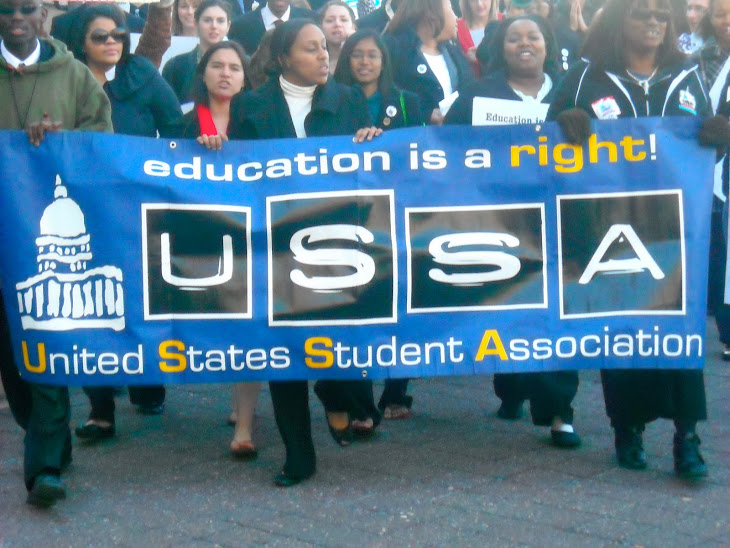
Written by Lindsay McCluskey, USSA President and Victor Sanchez, USSA Vice President

