Mar 30, 2010

President Obama Signs Historic Student Aid Reform Legislation into Law

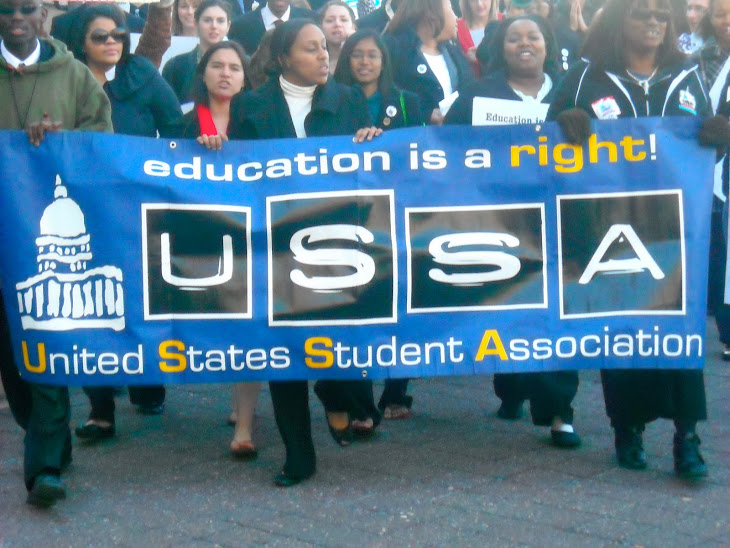
Today, in the auditorium of North Virginia Community College, President Barack Obama, joined by over fifty USSA members, signed the Health Care and Education Reconciliation Act of 2010 (HR 4872) into law.  This legislation includes the historic student aid reform proposal originally passed by the House of Representatives via the Student Aid and Fiscal Responsibility Act. 

The law appropriates over sixty billion dollars towards increases funding for the Pell grant, community colleges, Minority-Serving Institutions, and access and completion programs.  The increases are made possible through the elimination of wasteful government subsidies to private lenders that issue federal student loans.

“Today, students across the country were able to see their amazing direct-action organizing payoff with comprehensive student aid reform becoming the law of the land,” said United States Student Association (USSA) President Gregory Cendana.  “We thank President Obama, Education Secretary Arne Duncan, Speaker Nancy Pelosi, Education and Labor Committee Chair Congressman George Miller, and Health, Education, Labor, and Pensions Committee Chair Senator Tom Harkin, along with all the higher education champions who stood with students instead of banks in this fight for student aid reform.” 

While students celebrate this victory, our work is not over, as young people will continue fighting for policies that increase college access and affordability. USSA is currently working to pass the Development, Relief, and Education for Alien Minors (DREAM) Act, which would provide a pathway to citizenship and college access for undocumented youth, along with a pro-student federal budget that includes increase funding for college access, affordability, and completion programs.

Mar 26, 2010

Victory for Students as Historic Student Aid Reform Passes in Congress

Just two days after hundreds of students stormed Capitol Hill lobbying for increased federal action on college access and affordability, Congress passed the most sweeping overhaul of the student aid system in American history. The Healthcare and Education Reconciliation Act (HR 4872), passed both the House of Representatives and the Senate today after months of massive student support for the legislation.

“Today will go down in history as the day when the federal government chose to invest in college students over bank profits,” said United States Student Association (USSA) President Gregory Cendana. “By ending wasteful subsidies to private lenders and directing over sixty billion dollars of savings into financial aid programs, this legislation will ensure that millions of low-income and traditionally underrepresented students have access to higher education.”

The bill invests billions of dollars into the Pell grant, the cornerstone financial aid program that allows low-income students to attend college every year. Without passing this legislation, the Pell grant was jeopardy of being slashed by sixty percent. Additionally, HR 4872 invests billions of dollars in community colleges and Minority-Serving Institutions.

“Today the Senate listened to the American people by voting to… stop sending wasteful subsidies to big banks, instead of students,” said Education and Labor Committee Chair George Miller (D-CA), an ardent champion of college students. USSA, and students across the United States, applaud Chair Miller, Health, Education, Labor, and Pension Committee Chair Tom Harkin (D-IA), Speaker of the House Nancy Pelosi, and President Barack Obama for their continued devotion to college access and affordability.

While students nationwide celebrate this monumental victory, there is still much work that needs to be done to pass a student-friendly Fiscal Year 2011 budget and the DREAM Act. USSA’s 4.5 million college student membership will continue fighting these and other policies to make education a right.

Mar 16, 2010

A Different Kind of March Madness

This March, millions of young people are rallying nationwide in energetic crowds, chanting, singing and holding up signs, funneling their idealistic passion into a single cause of great importance to college students.  Sounds like the annual uproar surrounding NCAA basketball, right?  Well, this is a different kind of March Madness.

Throughout the first week of March, college students organized over 120 actions in over thirty states to rally against the historic divestment from higher education.  There was a laundry list of grievances to protest.  The Pell grant, once the cornerstone of student aid, has plummeted from covering seventy-two percent of the cost of college to just thirty-two, tuition increases have skyrocketed into the double-digits as states balance their budgets by slashing higher education funding, two-thirds of students are taking out mortgage-sized loans to pay for college, sending the average borrower nearly twenty-five thousand dollars in debt at graduation, and, as with the rest of America, students continue to struggle in one of the worst job markets on record.  So students spoke up and displayed a new kind of March Madness through massive 1960-style rallies, demonstrations, and marches.

These actions go far beyond exorcising the frustration felt by the nation’s debt-ridden students.  On March 20-23rd, over five hundred students are taking this vigor and enthusiasm to Capitol Hill to urge their Senators to pass a student aid reform proposal that has recently been included in the budget reconciliation bill.  The proposal, which mirrors the Student Aid and Fiscal Responsibility Act, encompasses President Obama’s plan to reform the student lending industry by eliminating the Federal Family Education Loan Program (FFELP), which allows the government to heavily subsidize private lenders to originate and service federal student loans.  Ending this program would save tens of billions of dollars that would go directly to students, through the aptly named Direct Loan Program, via increases to the Pell grant, low-interest rate Perkins Loans, access and completion programs, and investments in Minority-Serving Institutions.  Because all of these investments are paid for by funds that would have gone towards bank subsidies, the legislation doesn’t cost the taxpayers a dime.

Students overwhelmingly support the proposal.  During the 2009 National Student Congress, student aid reform was unanimously passed as a top legislative priority for the United States Student Association, which represents over 4.5 million college students.  Hundreds of student governments have subsequently adopted resolutions supporting the Student Aid and Fiscal Responsibility Act, and hundreds of thousands of students have contributed to a national “wall of student debt” with paper “bricks” exhibiting their personal and financial struggles to pay for college.  More recently, in the past few days since Senator Tom Harkin and Congressman George Miller announced that student aid reform would be included in budget reconciliation, college students sent over two thousand letters to Congress expressing support for this action.  Despite being swamped with debt, class loads, and an increasingly dire job prospects, on top of being the second most uninsured demographic for healthcare, college students have mobilized a coast-to-coast grassroots campaign to pass student aid reform.  National in breadth and substantive in depth, the campaign is moving from street protests to the Halls of Congress.

As with most underdogs, there is a Goliath to the students’ David.  The nation’s top private lenders are waging their own political campaign to stop student aid reform.  Lenders’ Political Action Committees (PACs), high-priced lobbyists, and million dollar warchests are mounting a formidable opposition to students and their prized legislation.  In 2009, lenders spent about four million dollars on lobbying; that’s the equivalent of twenty-five thousand dollars for every day Congress was in session last year.  PACs for lenders made over two million dollars in political contributions, with Sallie Mae’s PAC leading the pack with 194,000 dollars in donations.  So while students invest what little time and resources they have in passing real reform, big banks are pouring millions of dollars into obstructionist lobbying tactics aimed at maintaining a status quo that perpetuates a lending system that has led to the greatest amount of student debt in history.  These tactics may have swayed legislators from states with big lending influences, but students have not been fooled.  And while students may not have the kind of money that lenders so freely spend on lobbying, young people have power in numbers and passion and will bring both to Capitol Hill this weekend to fight for loan reform.

Against overwhelming odds, America’s youth has always fought the institutionalized, business-as-usual policies that garner profits over the advancement of socioeconomic justice.  Like their Great Society predecessors, today’s college student activists are our nation’s conscious.  And as March maddens, the fight for student aid reform is moving from local protests to the Nation’s Capitol.  Bring on the madness.
Mar 15, 2010

Students and Credit Card Debt: The Current and Coming Crisi


In light of the current budget crisis' going on in states throughout the nation, student's vulnerability to draconian credit card companies has never been so great. Considering the fact that the average undergraduate carried $3,173 in credit card debt in 2008, the case is great for involving students in the battle against credit debt exploitation. In addition with students' main avenue for paying for higher education, student loans, students find themselves being much more susceptible to credit card debt. The average student graduates annually with about $25,000 in student loan debt and, with the rising cost of higher education, credit cards seem enticing for many vulnerable consumers as a short term coping mechanism for the current financial crisis.

With that be said, it is important to garner support for a Credit Cardholder's Bill of Rights put forth by Representative Carolyn Maloney. Representative Maloney's bill does many things, but the points I focus on here surround students particularly. It protects students from excessive over the limit fees, implements fairness in a consumers payment to credit card companies, reduces overzealous penalizations aimed at burdened consumers, and protects vulnerable consumers from fee heavy subprime credit cards. The bill of rights does this by requiring that all fees for subprime credit cards be paid up front prior to issuance. It also asks that credit card companies limit the amount of over the limit fees they charge to just three. Currently, some credit card companies are allowed to charge their customers these fees without limits. Likewise, the bill prevents credit card companies from charging interest on payments made on time during a grace period. This practice is called "double cycle billing." Lastly, when consumers make payments on their debt, credit companies unfairly allocate those payments to balance with lower interest rates first. The bill makes it so that companies must allocate payments fairly amongst customers with debt of varying interest rates so that consumers aren't continuously locked into high interest rate debt.

The Credit Cardholder's Bill of Rights comes at a time when students need credit relief the most. With legislation like the Student Aid and Fiscal Responsibility Act, the American public has the opportunity to reel in the rampant abuse imposed on vulnerable consumers, like students, by socially irresponsible corporations and companies. Those who are often unequally impacted by credit card debt, low income and middle class families and individuals, would do well to back the Credit Cardholder's Bill of Rights. As a student myself, and a holder of considerable amounts of credit card debt, it would be a great disservice to me and others like myself to pass over this opportunity to reform the runaway credit system. It is with that personal investment in stopping the unending cycle of exploitative credit debt that I emphatically encourage students, parents, and families to make a call to your local representative to endorse and support Representative Carolyn Maloney's Credit Cardholder's Bill of Rights.

- By Edward Muna, University of Santa Barbara student and USSA Board member

Mar 9, 2010

Will You Be Counted in this Decade?

There aren't many subjects that seem as boring as the U.S. Census. Every ten years the federal government has to count everyone, so what? Why is it so important?

The truth is, filling out the Census is one of the most important things you can do this year. Data generated by the Census will determine where over $400 billion in federal funding is allocated over the next ten years. That's money that goes straight to your local hospitals, schools, and roads. All of this from a simple ten question survey that takes ten minutes to complete.

This is why the United States Student Association is ramping up studentsCOUNT! 2010, a campaign to encourage young people and people from underrepresented communities to fill out the census and educate their peers on why it is vital to complete. Click on the image on the right to view USSA's studentsCOUNT! 2010 campaign video to learn more about the Census and why it's important.


Mar 8, 2010

Students March 4 Education Across the Nation

On March 4, students from coast-to-coast, on campuses large and small, engaged in massive protests and rallies to promote college access and affordability. This grassroots movement, known as ‘March 4 Education,’ swept across the country in response to the historic crisis in public higher education as a result of crippling budget cuts and skyrocketing tuition and fee hikes.

“These actions were organized and executed largely by students themselves, which demonstrates the capacity of student power to bring college issues to the forefront of American politics,” said USSA President Gregory Cendana. “We cannot stop now. It is critical that this momentum be carried forward until local, state, and national governments recognize the social and economic importance of higher education and legislate accordingly.”

From mock funerals commemorating the death of public higher education in Washington and Michigan, rallies in the state capitols of Colorado, Florida, and Massachusetts, teach ins across New England, massive rallies in Georgia, and thousands of actions up and down California, millions of students made their opposition to education divestment known loud and clear.

The U.S. Senate is drafting its version of the Student Aid and Fiscal Responsibility Act, a bill that would financially help students faced with mortgage-level debt and uncontrollable college cost hikes. A vote is expected soon and students can voice their support for the bill by visiting http://www.usstudents.org/get-involved/ways-to-get-involved#student-aid-reform

The USSA National Student Congress voted unanimously to support student aid reform last summer. The organization’s 4.5 million college student membership has been working tirelessly on behalf of this legislation and will continue to do so until it is signed into law.

Mar 3, 2010

Student Aid Reform Rests in YOUR Hands!

The student voice is needed now more than ever. Sallie Mae, the nation's largest private lender and staunch opponent to student aid reform, is pushing its "alternative" to the Student Aid and Fiscal Responsibility Act (SAFRA) in the Senate. And Senators are listening. Stand up for the student voice by sending a letter in support of SAFRA to your senators!

Sallie Mae's alternative cuts billions of dollars that go directly to students through the Pell grant, Minority Serving Institutions, and access and retention programs. Additionally, the proposal allows private lenders to continue their predatory marketing tactics that leave students with high risk loans that often lead to default and bankruptcy. We cannot accept this alternative as REAL loan reform!

This policy would hurt students like Alexis, a University of Colorado, Boulder senior with $60,000 in loan and credit card debt. Under Sallie Mae's proposal, students like Alexis would continue to suffer without increased access to grant aid, low-interest rate loans, or access and retention programs guaranteed under SAFRA.
Don't let private lenders drown out the voice of students! In just one minute, you can be a forceful voice for legitimate and essential student aid reform by sending a message to your senators. It's easy! Simply:

1) Go to USSA's student aid reform letter to the senate webpage

2) Type in your zip code

3) Send the pre-written letter to your senators, or add your own thoughts.

4) Click send!

One minute of your time to send a letter to your senators could mean the difference between the greatest higher education investment in American history and more money for private lenders in the student loan system.

-Gregory Cendana, USSA President